Nature sure has created some tiny monsters when it comes to microbes—bugs that make us throw up, ooze pus, bleed out of our eyes and cough up blood. But which take top honors (or dishonors) for being the most lethal of all?
HIV/AIDS, the Global Tragedy HIV, the virus that causes AIDS
AIDS is a pandemic—a disease outbreak that is happening all over the world. In 2000 alone, 3,000,000 people died of AIDS. Since the AIDS pandemic began around 1985, almost 22,000,000 people have died from the disease. Right now, HIV infects more than 36,000,000 people across the world, so that death toll will definitely get a lot bigger over the next several years. HIV doesn’t kill people itself. Instead, the virus shuts down a person’s immune defenses—the tools used to fight off invading germs—by infecting and destroying important immune cells called T cells.
Once a person loses too many T cells, his or her body can no longer deal with other microbes that cause infections. HIV merely opens the floodgates. Eventually HIV-infected people become overrun by germs and die of lung infections, skin infections or other diseases. We now have several drugs that fight HIV. They cannot cure the infection, but they can keep it in check. Unfortunately, victims of HIV have to take several of these drugs every day for life and the drugs are very expensive. In Africa and other developing parts of the world where HIV is spreading most rapidly, most people don’t have enough money to buy these drugs. That’s why we can expect the death toll from HIV/AIDS to get a lot bigger over the next several years. Nature sure has created some tiny monsters when it comes to microbes—bugs that make us throw up, ooze pus, bleed out of our eyes and cough up blood. But which take top honors (or dishonors) for being the most lethal of all?
The Flu Virus— Even Deadlier than HIV? Influenza A viruses, one of the several types of flu viruses
Oh come on now, I’m sure you’re saying. The flu virus here in a list of the most lethal microbes? Sure, every year during what’s called "the flu season" tens of thousands of people get the flu. Despite feeling all achy and lousy for several days, most people eventually beat the virus and recover just fine. But that’s not how it went during the 1918 flu season. That year, World War I was raging so the effects of the flu virus sort of got overshadowed by the bigger, more obvious effects of bullets and bombs. However, in 1918 the flu virus killed at least 675,000 American people. Worldwide, it killed at least 21,000,000 people. These are low estimates. Some research now suggests that the flu may have killed 40,000,000 to 50,000,000 people around the world that year. Researchers still aren’t sure why the 1918 flu virus was so deadly.
Victims of the flu that year died in a gruesome way, the virus causing so much fluid to build up in their lungs so rapidly that it was like drowning. If higher estimates of how many people died from the 1918 flu are true, then the 1918 flu is the deadliest microbe ever in a single year. Thank goodness we haven’t seen a flu bug that deadly again—but will we someday? The Plague
The 1918 flu virus and HIV are the biggest killers of modern times. But back in the 14th century, the bacterium that causes bubonic plague, or the Black Death as it was also known, was the baddest bug of all.
In just a few years, from 1347 to 1351, the plague killed off about 75,000,000 people worldwide, including one-third of the entire population of Europe at that time. It spread through Asia, Italy, North Africa, Spain, Normandy, Switzerland, and eastward into Hungary. After a brief break, it crossed into England, Scotland, and then to Norway, Sweden, Denmark, Iceland and Greenland. Yersinia pestis, the plague bacteria Courtesy of Neal Chamberlain The plague bacterium is called Yersinia pestis. There are two main forms of the disease. In the bubonic form, the bacteria cause painful swellings as large as an orange to form in the armpits, neck and groin. These swellings, or buboes, often burst open, oozing blood and pus. Blood vessels leak blood that puddles under the skin, giving the skin a blackened look. That’s why the disease became known as the Black Death. At least half of its victims die within a week. The pneumonic form of plague causes victims to sweat heavily and cough up blood that starts filling their lungs. Almost no one survived it during the plague years. Yersinia pestis is the deadliest microbe we’ve ever known, although HIV might catch up to it. Yersinia pestis is still around in the world. Fortunately, with bacteria-killing antibiotics and measures to control the pests—rats and mice—that spread the bacteria, we’ve managed to conquer this killer. Ebola, the Bloody Virus
Some of you at the beginning of this page might have thought of the Ebola virus as the scariest, deadliest microbe you’ve ever heard of. Those of you who did so have probably seen the movie Outbreak or read The Hot Zone, which spotlighted this grisly virus.
Ebola virus Courtesy of CDC Ebola is definitely a nasty killer. It is part of a group of viruses that, among other effects on the body, cause the blood to stop clotting. Victims begin oozing blood from their mouths, noses, internal organs, even their eyes. It kills up to almost 90% of those who get infected.
With that kind of death rate, Ebola would be the deadliest microbe of all if it was more common. Fortunately, infections by this virus are pretty rare. There have only been seven outbreaks in humans. It has killed just over 800 people since the first outbreak in the Democratic Republic of the Congo (formerly called Zaire) in 1976. While outbreaks of this virus are rare and relatively small, Ebola is still one mean microbe that I wouldn’t ever want to tangle with.
“The governments on the list are trying to roll back the information revolution, and, for now, they are having success,” Simon added. “Freedom of expression groups, concerned governments, the online community, and technology companies need to come together to defend the rights of bloggers around the world.”
CPJ issued its report to mark World Press Freedom Day, May 3, and to call attention to online repression, a great emerging threat to press freedom worldwide. CPJ considers bloggers whose work is reportorial or fact-based commentary to be journalists. In 2008, CPJ found, bloggers and other online journalists were the single largest professional group in prison, overtaking print and broadcast journalists for the first time.
10. EGYPT
Egypt a country where more than 100 bloggers were detained last year alone.
Amer is jailed for insulting the president and Islam. (Reuters)
Authorities block only a small number of Web sites, but they monitor Internet activity on a regular basis. Traffic from all Internet service providers passes through the state-run Egypt Telecom. Authorities regularly detain critical bloggers for open-ended periods. Local press freedom groups documented the detention of more than 100 bloggers in 2008 alone. Although most bloggers were released after short periods, some were held for months and many were kept without judicial order. Most detained bloggers report mistreatment, and a number have been tortured.
Lowlight: Blogger Abdel Karim Suleiman, known online as Karim Amer, is serving a four-year prison term on charges of insulting Islam and Egyptian President Hosni Mubarak.
9. TURKMENISTAN
Turkmenistan, where the nation's first internet cafe was guarded by troops.
President Gurbanguly Berdymukhammedov promised to open his isolated country to the world by providing public Internet access. But when the country’s first Internet café opened in 2007, it was guarded by soldiers, connections were uneven, the hourly fee was prohibitively high, and authorities monitored or blocked access to certain sites. The Russian telecommunications company MTS, which entered the Turkmen market in 2005, started offering Web access from mobile phones in June 2008, but service agreements require customers to avoid Web sites critical of the Turkmen government.
Lowlight: Turkmentelecom, the state Internet service provider, routinely blocks access to dissident and opposition sites, while it monitors e-mail accounts registered with Gmail, Yahoo, and Hotmail.
8. CHINA
With nearly 300 million people online—more than any other country in the world—China has a vibrant digital culture. But Chinese authorities also maintain the world’s most comprehensive online censorship program, one emulated by many other countries. The government relies on service providers to filter searches, block critical Web sites, delete objectionable content, and monitor e-mail traffic. Because China’s traditional press is tightly controlled, bloggers often break news and provide provocative commentary. Blogs, for example, played prominent roles in spreading news and information about the 2008 Sichuan earthquake. But bloggers who go too far in promoting unpopular views or reporting sensitive information can find themselves in jail. At least 24 online writers are now in prison, CPJ research shows.
Lowlight: In 2008, the National Office for Cleaning Up Pornography and Fighting Illegal Publications announced that it had removed more than 200 million “harmful” online items during the prior year.
7. TUNISIA
Internet service providers are required to submit IP addresses and other identifying information to the government on a regular basis. All Internet traffic flows through a central network, allowing the government to filter content and monitor e-mails. The government employs an array of techniques to harass bloggers: conducting surveillance, restricting bloggers’ movements, and undertaking electronic sabotage. Online writers Slim Boukhdhir and Mohamed Abbou have served jail time for their work.
Lowlight: In a March address, President Zine El Abidine Ben Ali warned writers against examining government “mistakes and violations,” saying it was “an activity that is unbecoming of our society and is not an expression of freedom or democracy.”
6. VIETNAM
Bloggers have daringly tried to fill the gap in independent news that is left by the traditional state-controlled media. The government has responded with more regulation. Authorities have called on international technology companies such as Yahoo, Google, and Microsoft to provide information about bloggers who use their platforms. Last September, prominent blogger Nguyen Van Hai, also known as Dieu Cay, was sentenced to 30 months in prison on tax evasion charges. CPJ research shows the charges were in reprisal for his blogging.
Lowlight: In October 2008, the Ministry of Information and Communication created a new agency tasked with monitoring the Internet.
5. SAUDI ARABIA
Saudi Arabia, a country where an estimated 400,00 sites are blocked.
An estimated 400,000 sites are blocked inside the kingdom, including those that tackle political, social, or religious issues. Self-censorship is widespread. Aside from “indecent” material, Saudi Arabia blocks “anything contrary to the state or its system,” a standard that has been interpreted liberally. In 2008, influential clerics called for harsh punishment, including flogging and death, for online writers guilty of posting material deemed heretical.
Lowlight: Blogger Fouad Ahmed al-Farhan was jailed without charge for several months in 2007 and 2008 for promoting reform and the release of political prisoners.
4. CUBA
Cuba, where 21 bloggers are in jail.
Sánchez’s Generación Y is among a small but emerging group of independent Cuban blogs. (CPJ)
Only government officials and people with links to the Communist Party have Web access. The general population goes online at hotels or government-controlled Internet cafés by means of expensive voucher cards. A small number of independent bloggers such as Yoani Sánchez detail everyday life and offer criticism of the regime. Their blogs are hostedoutside the country and are largely blocked on the island. Two independent bloggers tell CPJ that they are harassed by authorities. Only pro-government bloggers can post their material on domestic sites that can be easily accessed.
Lowlight: The government now jails 21 writers who were on the leading edge of online journalism in the early part of the decade. These writers, all but one of whom was jailed in 2003, phoned or faxed their material to overseas Web sites for posting.
3. SYRIA
The government uses filtering methods to block politically sensitive sites. Authorities detain bloggers for posting content, even third-party material, deemed to be “false” or detrimental to “national unity.” Self-censorship is pervasive. In 2008, the Ministry of Communications ordered Internet café owners to get identification from all patrons, to record customer names and times of use, and to submit the documentation regularly to authorities. Human rights groups noted that authorities harass and detain bloggers perceived as antigovernment.
Lowlight: Waed al-Mhana, an advocate for endangered archaeological sites, is on trial for a posting that criticized the demolition of a market in Old Damascus.
2. IRAN
Iran, a country where a young blogger died in prison last month, was named as the second-worst country.
Authorities regularly detain or harass bloggers who write critically about religious or political figures, the Islamic revolution, and its symbols. The government requires all bloggers to register their Web sites with the Ministry of Art and Culture. Government officials claim to have blocked millions of Web sites, according to news reports. A newly created special prosecutor’s office specializes in Internet issues and works directly with intelligence services. Pending legislation would make the creation of blogs promoting “corruption, prostitution, and apostasy” punishable by death.
Lowlight: Blogger Omidreza Mirsayafi, jailed for insulting the country’s religious leaders, died in Evin Prison in March under circumstances that have not been fully explained.
1. BURMA
Burma has been judged the worst country in the world for online restrictions in a report looking at the repression faced by bloggers.
Bloggers inside Burma proved invaluable in passing out information during the September 2007 uprisings, leading to the ruling military junta blocking the Internet completely for a period, reports The Guardian.
Zarganar is serving a 59-year prison term. (AP)
Burma, which heavily censors print and broadcast media, has also applied extensive restrictions on blogging and other Internet activity. Private Internet penetration is very small—only about 1 percent, according to the Internet research group OpenNet Initiative—so most citizens access the Internet in cybercafés. Authorities heavily regulate those cafés, requiring them, for example, to enforce censorship rules. The government, which shut down the Internet altogether during a popular uprising in 2007, has the capability to monitor e-mail and other communication methods and to block users from viewing Web sites of political opposition groups, according to OpenNet Initiative. At least two bloggers are now in prison.
Lowlight: Blogger Maung Thura, popularly known as Zarganar, is serving a 59-year prison term for disseminating video footage after Cyclone Nargis in 2008.
For those who think a tropical island paradise or a Beverly Hills mansion is the ultimate key to contentment, think again; the happiest place in the world is, according to sociologists, far closer to home. In a new study aimed at charting each country's levels of happiness, Denmark has scored top marks, followed closely by Switzerland, Austria and Iceland. Britain came 41st, 18 places behind the United States.The study, conducted by the University of Leicester, compiled data from 178 countries and 100 global studies to map happiness across the world and found that countries with good access to healthcare and education came out on top.
The report's author, Adrian White, said the results showed that people in the West should realise how lucky they were. "The current obsession in the West about how unhappy we are really needs a reality check," he said. "I think one of the most destructive myths is that people in intense poverty are actually happy. Because if you believe that, why should you do anything?" Most of Africa and the former Soviet republics scored worst. Burundi, Zimbabwe and the Democratic Republic of Congo were the world's least happy places. The report did, however, contain some surprises. The tiny Himalayan nation of Bhutan, ruled by an autocratic monarch, came eighth, while nations such as Japan and France languished at 90th and 62nd respectively. Benjamin Holst, a Danish journalist, said that Denmark's high suicide rate - the second worst in Europe - and a recent rise in xenophobia should make people question just how content Danes were. "I'm not sure about these studies and I really wonder about the suicide rates in Denmark," he said. "I mean is it that we're so happy we kill ourselves? I really wonder about that."
On top of the world
* 1 Denmark * 2 Switzerland * 3 Austria * 4 Iceland * 5 Bahamas * 6 Finland * 7 Sweden * 8 Bhutan * 9 Brunei * 10 Canada
More than 10 million people in eight different countries are at serious risk for cancer, respiratory diseases, and premature death because they live in the 10 most polluted places on Earth, according to a report by the Blacksmith Institute, a nonprofit organization that works to identify and solve specific environmental problems worldwide.
Top 10 Worst Polluted Places Remote but Toxic Chernobyl in Ukraine, site of the world’s worst nuclear accident to date, is the best known place on the list. The other places are unknown to most people, and located far from major cities and populations centers, yet 10 million people either suffer or risk serious health effects because of environmental problems ranging from lead contamination to radiation.
“Living in a town with serious pollution is like living under a death sentence,” the report says. “If the damage does not come from immediate poisoning, then cancers, lung infections, mental retardation, are likely outcomes.”
“There are some towns where life expectancy approaches medieval rates, where birth defects are the norm not the exception,” the report continues. “In other places children's asthma rates are measured above 90 percent, or mental retardation is endemic. In these places, life expectancy may be half that of the richest nations. The great suffering of these communities compounds the tragedy of so few years on earth."
Top 10 Worst Polluted Sites Serve as Examples of Widespread Problems Russia leads the list of eight nations, with three of the 10 worst polluted sites. Other sites were chosen because they are examples of problems found in many places around the world. For example, Haina, Dominican Republic has severe lead contamination—a problem that is common in many poor countries. Linfen, China is just one of several Chinese cities choking on industrial air pollution. And Ranipet, India is a nasty example of serious groundwater pollution by heavy metals.
The Top 10 worst polluted places in the world are:
1. Chernobyl, Ukraine 2. Dzerzhinsk, Russia 3. Haina, Dominican Republic 4. Kabwe, Zambia 5. La Oroya, Peru 6. Linfen, China 7. Maiuu Suu, Kyrgyzstan 8. Norilsk, Russia 9. Ranipet, India 10. Rudnaya Pristan/Dalnegorsk, Russia
Choosing the Top 10 Worst Polluted Places The Top 10 worst polluted places were chosen by the Blacksmith Institute’s Technical Advisory Board from a list of 35 polluted places that had been narrowed from 300 polluted places identified by the Institute or nominated by people worldwide. The Technical Advisory Board includes experts from Johns Hopkins, Hunter College, Harvard University, IIT India, the University of Idaho, Mount Sinai Hospital, and leaders of major international environmental remediation companies.
Solving Global Pollution Problems According to the report, “there are potential remedies for these sites. Problems like this have been solved over the years in the developed world, and we have the capacity and the technology to spread our experience to our afflicted neighbors.”
“The most important thing is to achieve some practical progress in dealing with these polluted places,” says Dave Hanrahan, chief of global operations for the Blacksmith Institute. “There is a lot of good work being done in understanding the problems and in identifying possible approaches. Our goal is to instill a sense of urgency about tackling these priority sites.”
Every once in a while a film arrives which causes great controversy around the world, and in some cases, the film ends up being banned. This is a list of the top ten films that have caused controversy - and, in fact, many of them are still controversial to this day.
10. Last Tango in Paris [Bernardo Bertolucci, 1972]
The Story: While looking for an apartment, Jeanne, a beautiful young Parisienne, encounters Paul, a mysterious American expatriate mourning his wife’s recent suicide. Instantly drawn to each other, they have a stormy, passionate affair, in which they do not reveal their names to each other. Their relationship deeply affects their lives, as Paul struggles with his wife’s death and Jeanne prepares to marry her fiance, Tom, a film director making a cinema-verite documentary about her.
The Controversy: Critics and audiences were sharply divided over this X-rated erotic psychodrama. The film’s stark (as in naked) depiction of loveless, animalistic carnality horrified some — and landed its director and stars in an Italian court on obscenity charges.
9. Natural Born Killers [Oliver Stone, 1994]
The Story: The misadventures of Mickey and Mallory: outcasts, lovers, and serial killers. They travel across Route 666 conducting psychadelic mass-slaughters not for money, not for revenge, just for kicks. Glorified by the media, the pair become legendary folk heroes; their story told by the single person they leave alive at the scene of each of their slaughters.
The Controversy: Though intended as a satire on the media, the film actually inspired several copycat killers to seek their own 15 minutes of fame, some even using imagery and dialogue from the film. Over 12 murders in the U.S. and abroad have been linked to Killers. One victim’s family tried to sue Stone and Warner Bros.
8. The Birth of a Nation [D W Griffith, 1915]
The Story: Two brothers, Phil and Ted Stoneman, visit their friends in Piedmont, South Carolina: the family Cameron. This friendship is affected by the Civil War, as the Stonemans and the Camerons must join up opposite armies. The consequences of the War in their lives are shown in connection to major historical events, like the development of the Civil War itself, Lincoln’s assassination, and the birth of the Ku Klux Klan.
The Controversy: The film’s depiction of African Americans as childlike, conniving, or rabid sex fiends, and the Ku Klux Klan as heroic saviors, sparked nationwide protests by the nascent NAACP. (It also became a KKK recruiting tool.) Censorship debates and protests have dogged the film in subsequent rereleases and when it was added to the National Film Registry in 1993.
7. The Last Temptation of Christ [Martin Scorsese, 1988]
The Story: The carpenter Jesus of Nazareth, tormented by the temptations of demons, the guilt of making crosses for the Romans, pity for men and the world, and the constant call of God, sets out to find what God wills for him. But as his mission nears fulfillment, he must face the greatest temptation: the normal life of a good man. Based, not on the Gospels, but on Nikos Kazantzakis’ novel of the same name.
The Controversy: Religious fundamentalists picketed and threatened boycotts weeks before its release. One group offered to buy the $6.5 million film from Universal to destroy it; some theaters, and later Blockbuster, refused to carry it. Oh, and the French rioted.
6. JFK [Oliver Stone, 1991]
The Story: Details the actions of New Orleans District Attorney Jim Garrison, who takes it upon himself to investigate the assassination of President John F. Kennedy in Dallas, Texas, in 1963. Garrison is extremely suspicious of the official story presented by the FBI, and what he already knows and what he subsequently learns lead him to suspect that there is more to the story than the public is being told.
The Controversy: Some saw Stone’s documentary-on-steroids-like interpretation of those theories as lending them a certain patina of truth — raising fears that moviegoers would construe it as bona fide history. One result: a 1992 congressional act to release classified documents (which revealed nothing).
5. Deep Throat [Gerard Damiano, 1972]
The Story: Linda, frustrated that her hugely energetic sex life leaves her unsatisfied, seeks medical help. The doctor informs her that the reason for her problem is that her clitoris is mistakenly located at the back of her throat - but there is a very simple remedy, which the doctor, and various other men, proceed to demonstrate…
The Controversy: Intellectuals championed the film for striking a blow for First Amendment rights, while conservative leaders got it banned in many places and put Reems on trial for obscenity charges. Lovelace herself later denounced the film, claiming that while filming “there was a gun to my head.”
4. Fahrenheit 9/11 [Michael Moore, 2004]
The Story: In this film, muckraker Michael Moore turns his eye on George W. Bush and his War on Terrorism agenda. He illustrates his argument about how this failed businessman with deep connections to the royal house of Saud of Saudia Arabia and the Bin Ladins got elected on fraudulent circumstances and proceeded to blunder through his duties while ignoring warnings of the looming betrayal by his foreign partners.
The Controversy: The documentary lit the fuse of right-wing America, detonating protests and hate campaigns to ban it (no dice). Moore was the first to break the post-9/11 moratorium on Bush bashing and set off a season of brutal smack-downs among the Bill O’Reillys and Keith Olbermanns of the world.
3. Salò [Pier Paolo Pasolini, 1975]
The Story: Set in the Nazi-controlled, northern Italian state of Salo in 1944, four dignitaries round up sixteen perfect specimens of youth and take them together with guards, servants and studs to a palace near Marzabotto. In addition, there are four middle-aged women: three of whom recount arousing stories whilst the fourth accompanies on the piano. The story is largely taken up with their recounting the stories of Dante and De Sade: the Circle of Manias, the Circle of Shit and the Circle of Blood. Following this, the youths are executed whilst each libertine takes his turn as voyeur.
The Controversy: The film caused outrage throughout the world when it was released in 1975, and has proved a hot potato for film certification boards. In Britain, the first cinema to screen an uncut version of the film in 1977 was raided by police. A heavily cut version was shown until six years ago, when the British Board of Film Classification agreed to reclassify the movie.
2. A Clockwork Orange [Stanley Kubrick, 1971]
The Story: In a futuristic Britain, a gang of teenagers go on the rampage every night, beating and raping helpless victims. After one of the boys quells an uprising in the gang, they knock him out and leave him for the police to find. He agrees to try “aversion therapy” to shorten his jail sentence. When he is eventually let out, he hates violence, but the rest of his gang members are still after him.
The Controversy: That the movie first landed an X rating and was deemed pornographic across the U.S. was nothing compared with its reception in the U.K.: Social uproar and reports of copycat crimes led Kubrick to withdraw Clockwork from distribution in his adopted country. It wasn’t officially available there again — in theaters or on video — until 2000, a year after his death.
1. The Passion of the Christ [Mel Gibson, 2004]
The Story: The Passion of The Christ focusses on the last twelve hours of Jesus of Nazareth’s life. The film begins in the Garden of Gethsemane where Jesus has gone to pray after sitting the Last Supper. Jesus must resist the temptations of Satan. Betrayed by Judas Iscariot, Jesus is then arrested and taken within the city walls of Jerusalem where leaders of the Pharisees confront him with accusations of blasphemy and his trial results in a condemnation to death.
The Controversy: Gibson’s intention was to produce an unflinching depiction of Christ’s suffering on behalf of mankind. What resulted, however, was the ignition of a culture-war firestorm unrivaled in Hollywood history. For months prior to its release, The Passion was both denounced and defended sight unseen amid reports that the film wasn’t just brutal, but compromised by anti-Semitic sentiment. Gibson refused to let concerned parties view and vet his self-financed film.
USB drives comes in thousands of designs and colors, but these 10 are extraordinary weird. Or what do you think? Go ahead, check them out. They are weird! Promise. Hehe.
10. The iduck We start off with the least weird USB drive, and it’s the iduck from the Japanese company Solid Alliance. They are available in six different colors and the version on the picture even lights up when it’s plugged in. It’s cute so it’s not that hard to understand why it’s popular, right? iduck [Dynamism.com]
9. Sake bottle Now it’s starting to get weird. A USB drive shaped like a Sake bottle? Does that sound like the next big thing? Hehe, I wonder how many of these actually was produced! It’s so weird that it’s cool. USB Sake [Akihabara news]
8. Sushi If you already have bought the USB Sake, you definitely got to have a set of Sushi drives. They come in lots of different models and look really authentic. Don’t eat! Weird, eh? USB Sushi [Dynamism.com]
7. Mikan Seijin USB memory Ok, now it’s starting to get really weird, don’t you agree? This drive is called Mikan Seijin and if you translate that it means ‘Mandarin Alien’ - a popular Japanese TV show from 1994. It’s a relly horrible product. Hehe. Mikan Seijin USB memory [Engadget]
6. Big Tiki Drive Standing almost 4″ tall, the Big Tiki Drive is a really weird product. What’s the connection between Hawaii and storage? Once again, a product that is so weird that it becomes cool. Big Tiki Drive [Thinkgeek]
5. USB Sushi Dimsum This is just another dimsum Sushi USB drive, but they look so authentic that they deserve a better position in this Top 10 list. They even looks sticky! Only 5 weird USB drives to go, hang on! Sushidisk.co.uk
4. idisk The product description of this really strange product says it all: ‘It’s so small you can have it in your ear‘. Hehe, ok! How on earth should can you avoid not misplacing this really tiny (and very weird) product? iDisk Diamond, even in your ear [Akihabara news]
3. USB Fish Shrimp Once again: why? Why on earth would you want to have a little fish shrimp sticking out of your USB port? If you want to make it REALLY weird, combine this one with the USB Spaghetti plate port and you have a truly wild combination. Wild USB combo [Engadget]
2. USB Thumb The USB thumb is our runner up in the Top 10 weirdest USB drives ever. Having a thumb sticking out of your computer is really, really weird, and it also gives a completely new meaning to the expression ‘thumbdrive’.It looks very realistic, so you can probably use it in some pranks to your friends and colleagues. USB Thumb [Dynamism.com]
1. Barbie Yes, at last - the most weird USB drive ever - the USB Barbie. Rip the head off the cute Barbie doll, and plug it into your PC. This is as weird as it gets this time! Enjoy!
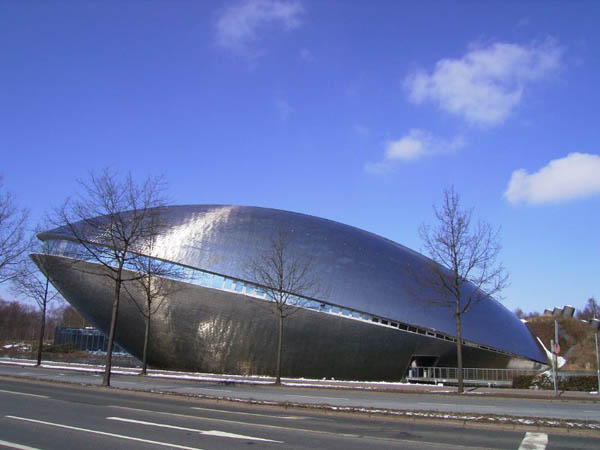
The Universum Bremen opened in September 2000 near to the University of Bremen, Germany. Covering over 4,000 m² the exhibition contains exhibits related to one of the three topics: mankind, earth and the cosmos. The science center building, with its 40,000 stainless steel scales, resembles a mixture between a whale and mussel. It was designed by the Bremen architect Thomas Klumpp.
The company Universum Managementges. mbH runs the science center as a private enterprise. About 3.4 million people visited the Universum in the first seven years since it opened.
In 2007 the Universum opened a large outdoor area, the EntdeckerPark, and a new building, the SchauBox. In contrast to the curved metallic older building, the SchauBox, developed by Haslob Kruse and Partner, is cubic with a rust-red exterior. It is used for additional exhibitions, which change annually.
The EntdeckerPark, the 5,000 m² outdoor area developed by Planungsguppe Grün, offers a number of hands-on exhibits, landscape elements and a 27m-high tower, called the Turm der Lüfte.
The concept of the exhibits and the interior design were realized by Kunstraum GfK mbH, Hamburg and Archimedia, Stuttgart.
9. Turning Turso in Molmo, Sweden
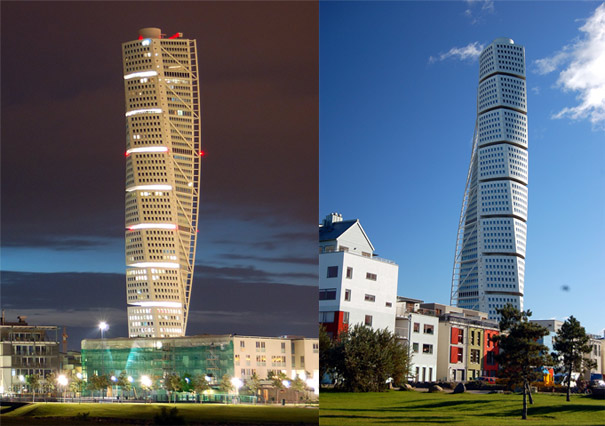
HSB Turning Torso is a skyscraper in Malmö, Sweden, located on the Swedish side of the Öresund strait. It was designed by the SpanisharchitectSantiago Calatrava and officially opened on 27 August 2005. The tower reaches a height of 190 metres (623 feet) with 54 stories. Upon completion, it was the tallest building in Scandinavia, the tallest residential building in the EU and the second tallest residential building in Europe, after the 264-metre (870 ft)-high Triumph-Palace in Moscow. A similar, taller skyscraper featuring the 90° twist is the Infinity Tower, currently under construction in Dubai, United Arab Emirates.
The 86-metre (280 ft)-high Kronprinsen was the tallest building in Malmö before Turning Torso.
The design is based on a sculpture by Calatrava called Twisting Torso. It uses nine segments of five-story pentagons that twist as it rises; the topmost segment is twisted ninety degrees clockwise with respect to the ground floor. Each floor consists of an irregular pentagonal shape rotating around the vertical core, which is supported by an exterior steel framework. The two bottom segments are intended as office space. Segments three to nine house 147 luxury apartments.
The Twisting Torso sculpture is a white marble piece based on the form of a twisting human being. Johnny Örbäck, former CEO of the Turning Torso contractor and Board Chairman of the Malmö branch of the co-operative housing association HSB, saw the sculpture in 1999 and contacted Calatrava to ask him to design a building using the same concept. Construction started in the summer of 2001.
One reason for the building of Turning Torso was to re-establish a recognizable skyline for Malmö since the removal of the Kockums Crane in 2002, which was located less than a kilometre from Turning Torso. The local politicians deemed it important for the inhabitants to have a symbol for Malmö — Kockumskranen, which was a large crane that had been used for shipbuilding and somewhat symbolised the city's blue collar roots.
As Turning Torso is a private residential building there is no access for the general public.
8. Edificio Mirador in Madrid, Spain
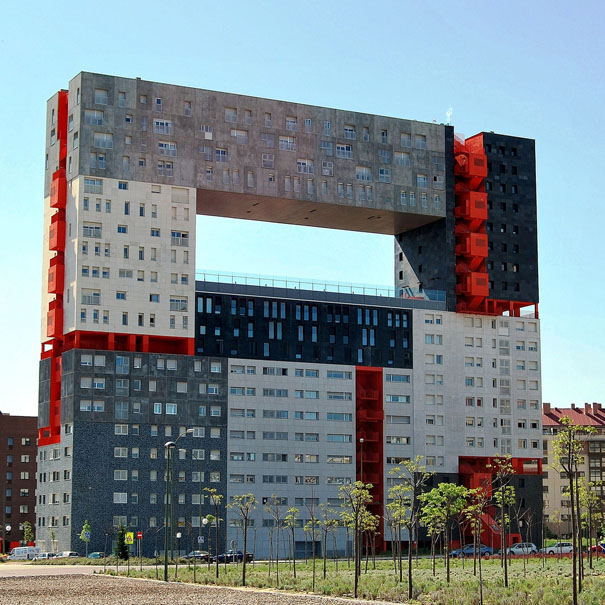
It’s a building developed by Dutch architects MVRDV. The building reaches 63.4 meters in height with 21 stories. The highlight of this building is the large central hole which is 36.8 meters above the ground. It’s the large lookout area that provides inhabitants with a community garden and a space from where they can contemplate the skyline.Different colors represent different blocks with its own planning, which offer at least 9 different types of apartments.
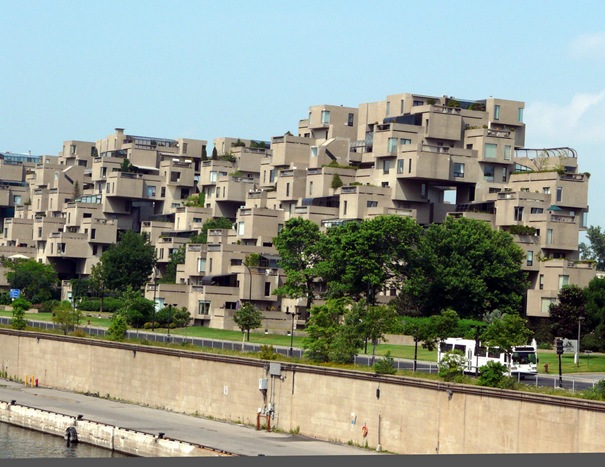
Expo 67 was nicknamed "Man and his World", taken from Antoine de Saint Exupéry's memoir Terre des hommes, (literally "Land of Men"), translated as Wind, Sand and Stars. Housing was one of the main themes of Expo 67. Habitat 67 then became a thematic pavilion visited by thousands of visitors who came from around the world. During Expo 67 it was also the temporary residence of the many dignitaries coming to Montreal.
It was designed to integrate the variety and diversity of scattered private homes with the economics and density of a modern apartment building. Modular, interlocking concrete forms define the space. The project was designed to create affordable housing with close but private quarters, each equipped with a garden. The building was believed to illustrate the new lifestyle people would live in increasingly crowded cities around the world.
The complex was originally meant to be vastly larger. Ironically, the building's units are now quite expensive rather than "affordable" due to its architectural cachet. It is owned by its tenants who formed a limited partnership that purchased the building from the Canada Mortgage and Housing Corporation in 1985.
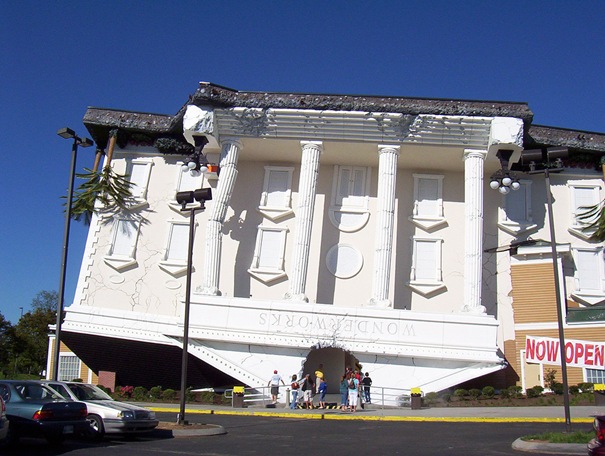
6. Wonderworks in Pigeon Forge, TN, United States.
WonderWorks began as a Top Secret facility on a remote island, in the middle of the Bermuda Triangle. As legend has it one experiment went awry, in an attempt to harness the power of a man-made tornado, the entire laboratory was hurtled skyward, hundreds of miles away, it landed upside down in the heart of Pigeon Forge TN. When you enter the building, everything will be upside down, so in order to participate in the fun, you must be inverted. Once you're properly aligned for your adventure, Family Fun awaits with more than 120 interactive, hands-on exhibits. As the Building hurtled skyward it encountered what can only be described as a time portal. Late in the 1900's a traveling Troop the Hoot N'Holler Players and their Cook Scraps were on a steamer ship headed for Europe and their big break. The Ill fated Steamer chose a course thru the Bermuda triangle where it disappeared and was never heard from again.
As the Building Emerged from the time portal, it had 5 new occupants, that's right Scrapps and the Hoot N' Holler players are here for you. Their mission, each night is to entertain you and your family and create memories that will last a life time. As you attend the Funniest Dinner Show in the Smoky Mountains you will enjoy a Hilarious evening of Fun. The cast sings & dances and Scraps tries to make his way into the show each night.
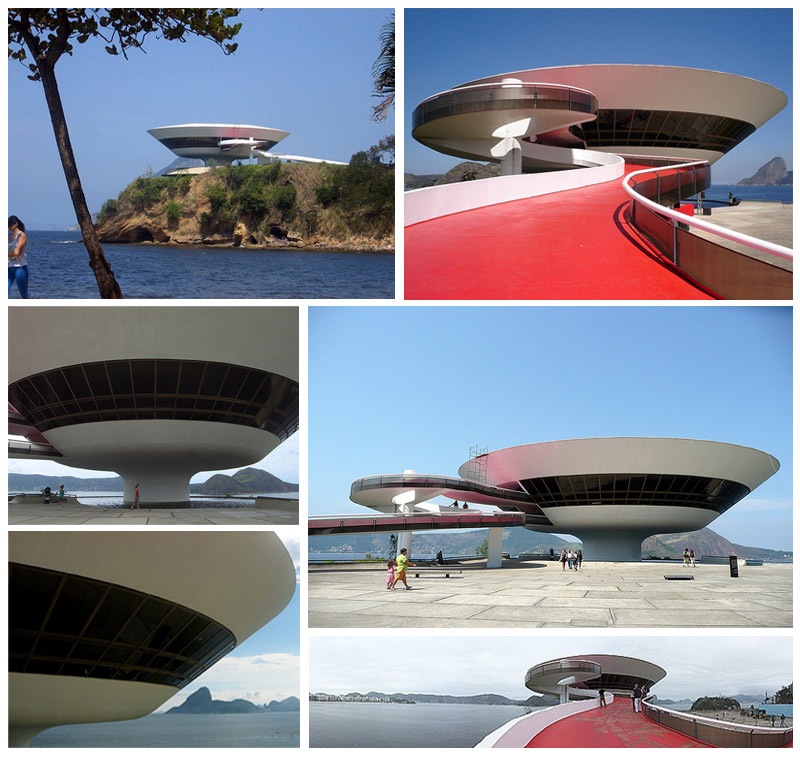
5. Museum of Contemporary Art in Niteroi, Rio de Janeiro, Brazil.
The Niterói Contemporary Art Museum (Museu de Arte Contemporânea de Niterói — MAC) is situated in the city of Niterói, Rio de Janeiro, Brazil, and is one of the city’s main landmarks.
Designed by Oscar Niemeyer with the assistance of structural engineer Bruno Contarini, who had worked with Niemeyer on earlier projects, the MAC-Niterói is 16 meters high; its cupola has a diameter of 50 meters with three floors. The museum projects itself over Boa Viagem (“Bon Voyage,” “Good Journey”), the 817-square meter reflecting pool that surrounds the cylindrical base “like a flower,” in the words of Niemeyer.
A wide access slope leads to a Hall of Expositions, which has a capacity for sixty people. Two doors lead to the viewing gallery, through which can be seen the Guanabara Bay, Rio de Janeiro, and Sugarloaf Mountain. The saucer-shaped modernist structure, which has been likened to a UFO, is set on a cliffside, at the bottom of which is a beach. In the film Oscar Niemeyer, an architect committed to his century (Marc Henri Wajnberg, 2000), Niemeyer is seen flying over Rio de Janeiro in a UFO, which then lands on the site, suggesting this as the origin of the museum.
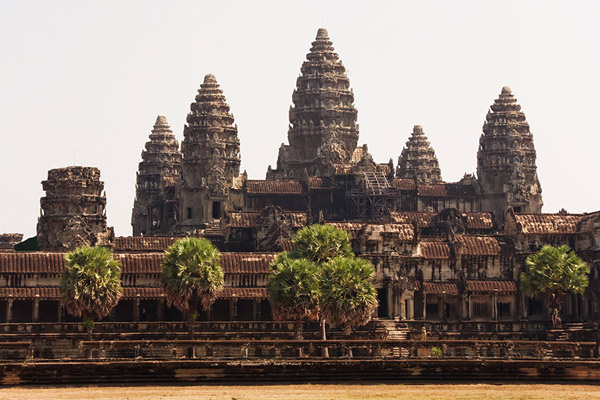
Angkor Wat (or Angkor Vat), is a temple complex at Angkor, Cambodia, built for the king Suryavarman II in the early 12th century as his state temple and capital city. As the best-preserved temple at the site, it is the only one to have remained a significant religious centre since its foundation—first Hindu, dedicated to Vishnu, then Buddhist. The temple is the epitome of the high classical style of Khmerarchitecture. It has become a symbol of Cambodia, appearing on its national flag, and it is the country's prime attraction for visitors.
Angkor Wat combines two basic plans of Khmer temple architecture: the temple mountain and the later galleried temple, based on early South Indian architecture, with key features such as the Jagati. It is designed to represent Mount Meru, home of the devas in Hindu mythology: within a moat and an outer wall 3.6 kilometres (2.2 mi) long are three rectangular galleries, each raised above the next. At the centre of the temple stands a quincunx of towers. Unlike most Angkorian temples, Angkor Wat is oriented to the west; scholars are divided as to the significance of this. The temple is admired for the grandeur and harmony of the architecture, its extensive bas-reliefs and for the numerous devatas (guardian spirits) adorning its walls.
The modern name, Angkor Wat, in use by the 16th century, means "City Temple": Angkor is a vernacular form of the word nokor which comes from the Sanskrit word nagara (capital), while wat is the Khmer word for temple. Prior to this time the temple was known as Preah Pisnulok, after the posthumous title of its founder, Suryavarman II.
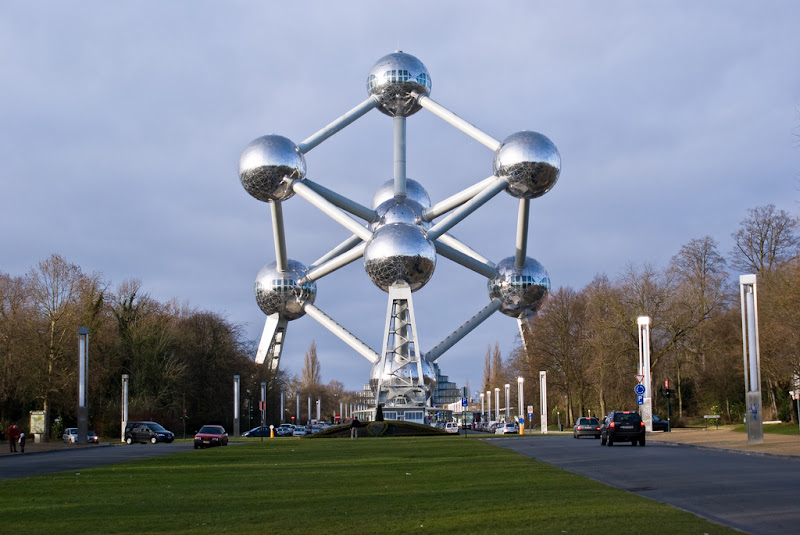
The Atomium is a monument built for Expo '58, the 1958 BrusselsWorld's Fair. Designed by André Waterkeyn, it is 102-metres (335 ft) tall, with nine steelspheres connected so that the whole forms the shape of a unit cell of an ironcrystal magnified 165 billion times.
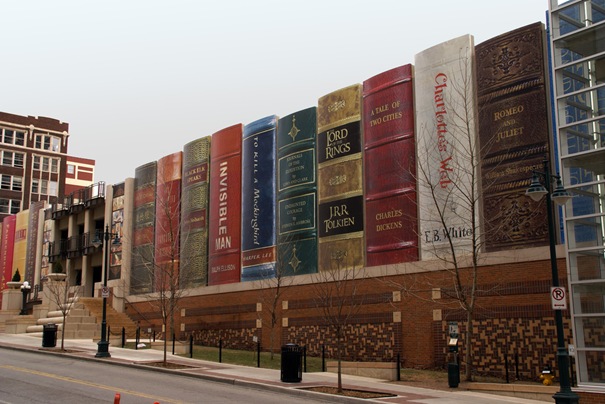
Tubes which connect the spheres along the 12 edges of the cube and all eight vertices to the centre enclose escalators connecting the spheres which contain exhibit halls and other public spaces. The top sphere provides a panoramic view of Brussels. Each sphere is 18 metres in diameter. Three spheres are currently (2008) closed to the visitors, others are easily reachable with escalator. The vertical vertex contains a lift which was considered very fast and advanced at the time of building (the speed is 5 m/s). 3. Kansas City Library in Missouri, USA.
The Sam Kee building is situated at 8 West Pender Street. It runs from the corner of Pender and Carral to the lane at the halfway point of the block. It is two storeys tall and 1.5 meters (six feet) deep. The story behind the building is as exotic as the structure with several intriguing twists and turns included in its telling. The City of Vancouver provided the original owner, Chang Toy, with a challenge when it expropriated all but two meters of his property as part of an expansion of Pender Street. No compensation was provided to its owner who was left with what most believed to be a useless property. In a creative turn of events fuelled by spite and some say a bet an architect was hired to design a building to fit the remaining property. The rest is history in more ways than one.
This building was home to 13 businesses at one time. It was the only place in Chinatown for residents to enjoy hot baths. There is a tunnel beneath the building that was used as an escape route from raids on Opium dens situated on neighbouring Shanghai Alley. The building is also fronted by the only remaining glass sidewalk in Chinatown. As part of the ongoing history of this structure, issues still arise between the owners and the city with respect to encroachment and overhangs. In spite of each side having an element of right it seems to boil down to the proverbial "tit for tat". It makes for an interesting study in civics.
SOON....
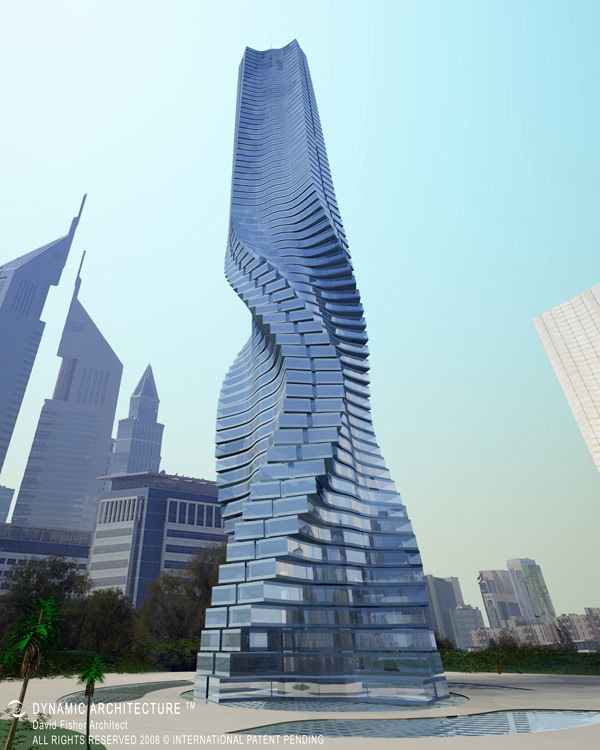
Rotating Tower in Dubai, UAE (scheduled on 2010)
(Image: Dynamic Architecture ™ all rights reserved to Dr. David Fisher)
(Image: Dynamic Architecture ™ all rights reserved to Dr. David Fisher)
(Image: Dynamic Architecture ™ all rights reserved to Dr. David Fisher)
Location: Dubai, United Arab Emirates Date: scheduled on 2010 Architect:Dr. David Fisher Purpose: multipurpose (offices, hotel, residential apartments) More info: We have seen tall buildings, we have seen strange buildings, but have you seen buildings in motion that actually change their shape? Sounds unbelievable but not to Dr. David Fisher.
Visionary architect Dr. David Fisher is the creator of the world’s first building in motion - the revolutionary Dynamic Tower. It will adjust itself to the sun, wind, weather and views by rotating each floor separately.
This building will never appear exactly the same twice.
It is amazing but you will have the choice of waking up to sunrise in your bedroom and enjoying sunsets over the ocean at dinner.
In addition to being such an incredible engineering miracle it will produce energy for itself and even for other buildings because it will have wind turbines fitted between each rotating floor (picture 2). So an 80-story building will have up to 79 wind turbines, making it a true green power plant.
The Dynamic Tower in Dubai will be 1,380 feet (420 meters) tall, 80 floors, apartments will range in size from 1,330 square feet (124 square meters), to Villas of 12,900 square feet (1,200 square meters) complete with a parking space inside the apartment. It will consist of offices, a luxury hotel, residential apartments, and the top 10 floors will be for luxury villas located in a prime location in Dubai.
The Dynamic Tower in Dubai will be the first skyscraper to be entirely constructed in a factory from prefabricated parts. So instead of some 2000 workers, only 680 will be sufficient. Construction is scheduled to be completed by 2010.


 10. The iduck
 9. Sake bottle
 7. Mikan Seijin USB memory
 6. Big Tiki Drive

 3. USB
  2. USB Thumb